How Much Does Website Redesign Cost in 2026?
Website redesign cost for a B2B company is usually somewhere between $5,000 and $50,000, while enterprise or replatforming projects can go well past that. However, a single number won't help you much, because "redesign" covers everything from new colors to a full platform migration and a redirect map.

Website Redesign Cost Breakdown
A B2B website redesign costs $5,000 to $20,000 for a mid-sized marketing site and $20,000 to $50,000 or more for enterprise scope, based on GoodFirms' May 2026 survey. According to Clutch data, the average website design cost stands at $38,105.
| Site type | Most common range | Share of agencies | Typical timeline |
|---|---|---|---|
| Basic site or MVP | $1,000 to $3,000 | 59.9% | 2 to 4 weeks |
| CMS-based site | $5,000 to $20,000 | 45.4% | 4 to 8 weeks |
| Mid-sized site | $5,000 to $20,000 | 53.9% | 4 to 8 weeks |
| Enterprise site | $20,000 to $50,000 | 36.2% | 8 to 28 weeks |
| SaaS website | $25,000 to $80,000 | 61% | 16 to 40 weeks |
Source: GoodFirms Website Construction Cost Survey 2026.
However, the "average cost for website redesign" is a shaky number to plan around. A small number of large projects drags the average far above what a typical buyer pays, which is why ranges by site type tell you more than any single average.
For a B2B company, website redesign and a new build end up costing about the same once the scope goes past visuals. The only version that comes in cheaper is a visual refresh that keeps the existing templates, structure and URLs.
4 Engagement Tiers in Website Redesign Pricing
The tier you choose sets your website redesign pricing. Each tier below changes a different amount of the site, carries a different level of SEO risk, and needs a different specialty.
| Tier | What changes | Typical range (source) | Timeline | Best for |
|---|---|---|---|---|
| Refresh | Visuals on existing templates | $1,000 to $20,000 (GoodFirms basic and CMS bands) | 2 to 8 weeks | Sound structure, dated look |
| Rebuild | IA, templates, copy, CMS | $5,000 to $50,000 (GoodFirms mid-sized bands) | 4 to 16 weeks | Site no longer sells the offer |
| Replatform | New platform plus migration | $20,000 to $200,000 (GoodFirms enterprise bands) | 8 to 28 weeks | Outgrown WordPress, Wix or HubSpot |
| Embedded partner | Ongoing build, SEO, CRO | $500 to $6,000+ per month (GoodFirms retainers) | Ongoing | Site as a growth channel |
However, read these website redesign prices as market context for your budget. Each agency’s quote comes from a scoped brief.
#1. Refresh on the Existing Platform
A refresh puts a new visual layer over the templates, CMS structure, and URLs you already have. Because no URLs change, it's the lowest-risk option for search traffic, and it can ship in a few weeks. It fits when your analytics say the structure works (people find the pricing page, demo requests come from the pages you'd expect) and the problem is that the brand looks five years old.
The catch shows up when the site has a messaging problem. If visitors can't tell what you sell immediately, new typography and a fresh color palette won't change that, and you'll be back to scoping a rebuild within a year.
A refresh quote should still carry QA across browsers and devices, a page speed check and a pass over the metadata, because new fonts, images, and scripts can slow the site down even when nothing structural moves. If those lines are missing, the low price is partly explained by the work that's been left out.
#2. Website Rebuild
A website rebuild means new information architecture, new page templates, rewritten copy, and rebuilt CMS collections. It’s what companies usually mean when they say "redesign." This is where strategy work earns the cost, since the site map and the messaging get decided before a single screen is designed.
As an embedded growth partner, Tunel Studio keeps strategy, design, build, SEO/GEO, and launch inside one team, and we set the timeline in the scope before work starts.
#3. Website Migration
A replatform moves the website from WordPress, Wix, or HubSpot to a new platform such as Webflow, which adds content migration, redirect mapping, and integration rework on top of everything in a rebuild.
Also, a WordPress to Webflow migration changes the running costs, since plugins, hosting, and patching get replaced by a platform subscription, and Webflow vs. WordPress pricing over a few years is worth working out before you decide.
Two Tunel Studio projects show the scale involved:
- WealthHub rebrand and rebuild covered 20+ new pages, 250+ migrated blog pages, and a domain move from miltonfmr.com to wealthhubtrading.com with a full redirect map. It launched in six weeks with organic clicks doubling afterwards.
- Cognitive Design Systems moved from Wix to Webflow with 25+ pages and copy written from scratch for a technical audience. That site launched in eight weeks, and impressions grew 4.3x with organic clicks up 37% compared with the same period a year earlier.
#4. Embedded Growth Partner
An embedded growth partner keeps everything under one roof, building, shipping, and improving the website, working as a part of your team.
This tier fits when the website is a pipeline channel that needs new landing pages, SEO work, and growth. For example, we've been Calda's partner since March 2024, through three versions of the site across 30+ pages, with SEO and GEO built into each cycle. Organic clicks rose 70% year on year and impressions 3.9x.
What Drives the Cost of a Website Redesign
In the GoodFirms 2026 survey, companies named custom back-end development (70%), AI and automation features (51%), and client revisions (49%) as the biggest cost drivers.
Page Templates
A 60-page site built from eight templates costs less than a 30-page site with 20 unique layouts, because the design and build work happens per template and each new page on a template is mostly content entry. Ask every agency to price per template, and the quotes become comparable.
As an illustration, eight templates cover a lot of B2B websites:
- Homepage
- Solution page
- Industry page
- Case study
- Blog post
- Pricing
- Contact
- Legal
A site that needs a custom layout for every solution and every industry can easily triple that count, and the quote follows.
Copy and Content
Who writes the copy changes the quote more than buyers expect. Agency-written copy adds messaging work, interviews with your sales team or founders, and review rounds, while the copy you supply yourself takes that work off the agency's estimate.
GoodFirms lists content delays as one of the hidden costs in website projects, and a design that waits three weeks for copy keeps a team booked and a launch date slipping. If you're writing it in-house, put a named owner and a delivery date into the plan.
A middle route works well for technical B2B products. Your product and sales people supply the raw material (feature notes, objections they hear on calls, customer quotes) and the agency turns it into page copy. You pay for writing and structure, and the agency skips the weeks of interviews it would need to learn your product from nothing.
CMS Structure and Migration
Every CMS collection (blog, case studies, resources, team, glossary) needs its own fields, a template, and a migration plan for the items already in it. If you’re on Webflow, collection count and item volume decide which site plan you need, and the plan limits are worth checking against your current item count before you scope.
The walkthrough below shows where Webflow lists each collection with its item count, and how to export one for the redirect map.
Redirects should be a quote on their own. You need a map from every old URL to the new one, permanent server-side redirects, kept for at least a year after migration. Setting up redirects is quick once the map exists, and building the map is where the hours go on a site with a few hundred URLs.
Integrations
CRM forms, marketing automation, scheduling, gated content, and product data all need connecting and testing. Third-party integrations often run two to three times over their first estimate, which makes them the line item to question hardest in any proposal.
HubSpot is the common case for B2B teams. A HubSpot to Webflow migration can keep HubSpot forms and the CRM in place while the website itself moves, so the integration work comes down to wiring forms and tracking correctly while the sales stack stays as it is.
Analytics and consent belong on the same line. GA4 events, conversion tracking for ad platforms and a cookie consent setup that works in the EU all take testing time, and a site that launches without them leaves you unable to compare the new conversion rate with the old one.
Localization
Every added language multiplies copy, QA, and SEO work, because each locale needs its own translated pages, metadata, and hreflang setup. Buyers in Germany, Austria and Switzerland usually need German and English at a minimum, which can add a large share to the content and QA budget.
The platform side has its own cost. For instance, Webflow sells localization as an add-on to the site plan, and Webflow localization pricing depends on how many locales you add.
Accessibility and Compliance
The European Accessibility Act (Directive (EU) 2019/882) applies to the products and services it covers, including e-commerce services sold to EU consumers. A B2B marketing site that only collects leads may fall outside this scope, so check with your counsel before you budget for a full audit.
Whatever the legal answer, building to WCAG from the first template costs less than fixing contrast, focus states and heading order on 40 finished pages. The ways to improve accessibility are cheap at the design stage and slow at the QA stage.
Agency Location and Team Model
Hourly rate is the multiplier on every driver above. GoodFirms found that 57% of firms bill $50 to $100 an hour. However, that doesn’t make hiring in-house automatically cheaper. The U.S. Bureau of Labor Statistics puts the median web developer wage at $92,650 a year, and a single hire rarely covers strategy, design, build, SEO, and copy for a full redesign.
A team based in the Balkans works in EU time zones and sits between these bands, which is part of why DACH and U.S. companies hire nearshore. The rate difference only pays off if the team covers the same scope, so compare what each quote includes before you compare the hourly number.
The team model changes the bill as well. Splitting a redesign across a design studio, a development shop, and an SEO agency gives you six communication paths to manage instead of one, and the briefing, file passing and scope disputes between them land on your side without appearing on any invoice. The cost of coordinating three agencies can outweigh the gap between their hourly rates, which is why one team covering design, build and SEO often comes out cheaper over the whole project.
Has AI Made Website Redesigns Cheaper?
AI has made simple websites cheaper to build, but a low first invoice can turn into a second, larger one when the site has to be fixed. GoodFirms 2026 found that 98% of surveyed agencies now use AI in their workflow, and it lists rework on AI-generated code as one of the new hidden costs.
B2B teams often reach out to Tunel Studio after paying less for a site put together quickly with AI tools, and the brief is to fix it. The copy reads like every other site in the category, the layouts look finished in a screenshot and fall apart on a phone, and the build has no clean class structure, so nobody on the team can edit one page without breaking another. Search basics like heading order, metadata and redirects from the old URLs are often missing too.
Fixing an AI-built site can mean rewriting the copy, rebuilding the templates, and adding the skipped SEO groundwork, which puts the repair close to a full rebuild paid on top of the original invoice.
For a test page or an MVP, a cheap AI build is a reasonable bet. For a B2B site that has to carry positioning, proof-backed copy, and a few hundred migrated URLs, AI shortens production hours, and the strategy, writing and migration still need people who've done that work before.
Post-Launch Website Redesign Costs
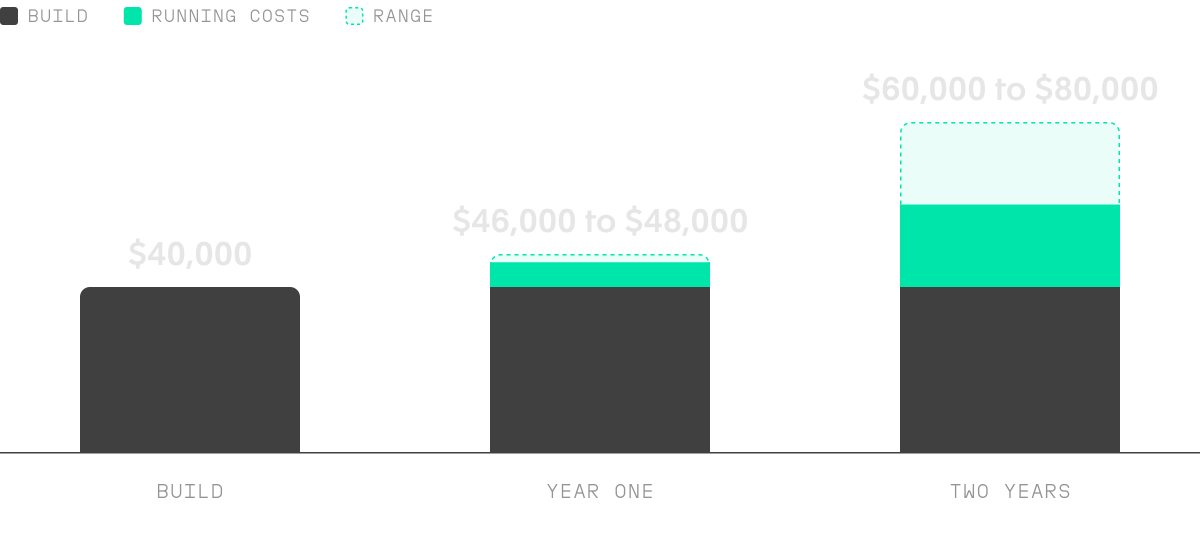
Plan for annual maintenance at 15 to 20% of the build cost and a two-year total of 150 to 200% of the initial invoice. The recurring costs are predictable once you list them:
- Platform or CMS subscription and any user seats
- Hosting, app and integration subscriptions
- Security and software updates
- Content updates
- Ongoing SEO/GEO
- Retainer if you have one
Some platforms bundle hosting and updates into one subscription, while others bill hosting, plugins and patching separately, so ask every agency to list the running costs of the platform they propose.
Also, keep in mind a useful rule for website redesign timing. A rebuild makes sense once annual maintenance passes 30% of a rebuild estimate. As an illustration with round numbers, if a rebuild is quoted at $40,000 and you're spending more than $12,000 a year patching plugins, fixing layouts and working around an old CMS, the rebuild starts paying for itself.
Search work keeps going after launch as well, because new pages need to rank and the ones you migrated need watching while Google settles on the new URLs.
How to Make a Webflow Website Redesign Cost Estimate
You can make a Webflow website redesign cost estimate before talking to any agency by listing seven inputs that drive every quote. Agencies price the same inputs, so writing them down first makes their proposals comparable:
- Pick the engagement tier: refresh, rebuild, replatform or embedded partner.
- List the unique page templates you need, and leave the total page count aside.
- List every CMS collection and how many items each one holds today.
- Count the URLs that will change and will need a redirect.
- List integrations: CRM, forms, scheduling, analytics and any product data.
- Decide who writes the copy and how many languages you need.
- Add 12 months of platform, maintenance and support costs to the build figure.
A marketing site rebuild typically costs $5,000 to $50,000 and takes 4 to 16 weeks, based on the GoodFirms Website Construction Cost Survey 2026.
Send your estimator result and the seven inputs with your brief. When three redesign agencies price the same eight templates, four collections and 180 redirects, the differences between their quotes come from approach and team, which is the comparison you actually want to make.
Keep a buffer line for integrations. Third-party integrations frequently run two to three times over their first estimate, so a CRM connection quoted as a small item deserves a second look, and asking the agency how they'd test it usually shows whether the estimate is realistic.
Final Thoughts
The cost of website redesign follows the tier you choose and the drivers you control, i.e. templates, content, migration, integrations, languages, and who does the work. Third-party ranges give you a sanity check, and a scoped quote gives you the real number.
Once you have a range, a second opinion on a real quote is cheap insurance. Finished B2B and SaaS sites show what a scoped project turns into, and a quick strategy call lets you talk your numbers through.
How long does a website redesign take?
A website redesign takes 4 to 8 weeks for a mid-sized site, 8 to 28 weeks for enterprise builds, and 16 to 40 weeks for SaaS websites. Content readiness and the number of people signing off tend to stretch a timeline more than design or development does.
How often should a B2B company redesign its website?
There's no fixed cycle. Redesign when the site no longer matches what you sell, when conversion drops, or when annual maintenance passes 30% of a rebuild estimate. Between redesigns, small monthly improvements keep the site from aging all at once and push the next rebuild further out.
Is it cheaper to redesign or build a new website?
A visual refresh on your existing templates is cheaper than a new build. Once the structure, templates and CMS change, a redesign costs about the same as starting fresh, because the work is the same: new architecture, new templates, new content and a migration of what you keep.
Will a website redesign hurt my SEO?
A redesign can cost you rankings if URLs change without a redirect map. Google says to expect temporary ranking changes during a site move and to keep redirects for at least a year. Price migration, redirects and a post-launch Search Console check into the quote so they don't get cut.
Should I pay a deposit before a redesign starts?
Fixed-price redesigns are usually billed in milestones, and the first payment often covers discovery. Before you sign, ask what each payment unlocks, what you own at each stage, and what happens to the money already paid if the scope changes halfway through the project.
Do Webflow agencies charge more than WordPress agencies?
GoodFirms 2026 puts the most common range for both WordPress and Webflow builds at $3,000 to $40,000, so the platform itself barely moves the build price. Scope matters far more. Where Webflow can save money is after launch, with fewer plugins to update and no separate hosting to manage.


Your growth starts with one conversation.
No pitch deck. No pressure. A focused 30-minute call about where you are, where you want to be, and whether we're the right team to get you there.