One Team vs. Three Agencies: The Real Cost of Coordination
Agency coordination problems start when your website's design, development, and SEO are run by three different agencies and you become the project manager between them. The invoices are easy to see. The hours your team spends relaying briefs, chasing files and refereeing scope disputes don't show up on any of them, and for a B2B company under 200 people that second number is usually the bigger one.
What Are the Most Common Agency Coordination Problems?
The most common agency coordination problems are the delays, rework, and lost accountability that appear when a company splits connected marketing work across several agencies. Each agency works to their own scope, so handoffs, shared decisions, and reporting fall to the client. The costs are slower launches, duplicated effort, and results nobody owns.
The symptoms of poor agency coordination are easy to spot once you know them:
- You re-explain the same brief to every vendor, and each one hears something slightly different.
- Status meetings multiply but decisions don't.
- Each agency reports a different number for the same goal.
- Launch dates are delayed because one agency waits on another for files, access, or sign-off.
- Problems get escalated to you instead of being solved between the agencies.
- Nobody can say who owns the result.
3 Reasons Why Multiple Agencies Cost More Than the Invoices
Multiple agencies cost more than their invoices because each invoice only covers the work inside one scope. The coordination around them (briefing, relaying, waiting, reconciling) has no line item, so it lands on your calendar.
That said, here are the three reasons why that is so.
#1. Communication Flow
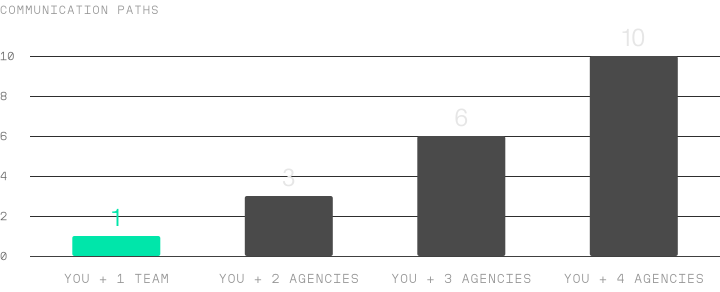
Software project managers have had a formula for this since the 1970s. Under Brooks' law, when n parties have to coordinate with each other, the number of communication paths grows as n(n-1)/2, and the time spent working those paths is time nobody spends producing anything.
Run your own setup through it. You plus one team is two parties and one path, and you plus two agencies is three parties and three paths. You plus a design agency, a development agency, and an SEO agency are four parties and six paths, and adding a paid media agency takes it to ten.
#2. Your Own Time
Asana's Anatomy of Work Index, a survey of 10,223 knowledge workers in the U.K., the U.S., Japan, Australia, New Zealand, and Germany, found that 60% of their time went to work coordination, such as status updates, searching for information and managing shifting priorities. Only 27% went to the skilled work they were hired to do, and 13% to strategy.
In a three-agency website project, someone on your side forwards the brand guidelines three times, sits in three kickoff calls, and chases the developer for staging access so the SEO agency can crawl it. That person is usually the marketing lead, whose hours you can least afford to spend relaying messages.
Forrester describes how this builds up in B2B. Organizations onboard agencies for different types of work as they grow, often without any overarching coordination in place, and the marketing team ends up spending more time managing agencies than doing the work itself. Nobody designs the setup. It builds up one contract at a time.
#3. Handoffs
Every handoff loses some context. A designer's intent isn't fully conveyed in a Figma file, and a developer's build decisions rarely reach the SEO agency until something breaks in the Search Console.
On a Webflow site that’s even more specific. The development agency decides the class structure, the CMS collections, and the slug pattern for blog posts and case studies, and it makes those calls without the SEO agency in the room. Months later the SEO agency wants a different URL structure, which means rebuilding collection templates and redirecting every live item.
A team that handles Webflow design and development and SEO/GEO together makes the URL decision once, while the sitemap is still a spreadsheet.
One Team vs. Three Agencies Comparison
Here's how the two setups compare on the points that decide whether a website project ships on time:
"Embedded" has a practical meaning here. For instance, Tunel Studio works as an embedded growth partner inside the client's marketing operations, with a shared Slack channel, weekly standups, and one group of people who design, build, and rank the website. The same people hear the brief, and the same people ship it.
SEO starting from the sitemap is the row that changes outcomes the most. When SEO and GEO services sit in the same team as the build, keyword targets shape the page list, the URL structure is set before the first CMS collection exists, and the redirect map gets written while the old site is still live.
Do You Have Too Many Agencies? A 7-Question Self-Audit
To see if you have too many agencies on your list, answer the following seven questions truthfully with yes or no:
How to Consolidate Agencies Without Losing the Work
Consolidating agencies without losing the work means securing your assets first, then moving scope, then ending contracts. Start with an access audit. For each agency, list what it controls:
- Webflow Workspace and site ownership
- Domain registrar and DNS records
- Google Analytics and Google Search Console properties
- Figma files and the design system
- CMS content, including drafts and archived items
- The redirect map and any crawl exports of the old site
The Webflow site should sit in your Workspace plan, with agencies added as members. If it currently sits in an agency's Workspace, moving it is the first task. From there you can invite collaborators in Webflow for the new team without handing anyone ownership.
Plan an overlap window so the outgoing agency is still reachable while the new team finds what was never documented. Then budget the new scope from the work itself.
If the consolidation includes a platform change, such as a WordPress to Webflow migration, treat it as its own project with its own redirect map and launch checklist, since a scope transfer and a URL change are happening at once.
What Changes When One Team Owns Design, Build, and SEO?
When one team owns design, build, and SEO, the decisions that usually fall between agencies are all under one roof. The URL structure is set before the build starts, redirects are planned before launch, and one report tracks the goal everyone is working toward, so the handoffs stop being the client's job.
Tunel Studio is set up around that model. One embedded team designs the site, builds it, ranks it, and keeps growing it after launch.
For example, two of our recent projects show how our embedded growth model plays out from different starting points: Finmatics needed a platform migration, and WealthHub needed a full rebrand on a new domain.
Finmatics
Finmatics serves tax advisors and companies across the DACH region. Their HubSpot website had become a growth bottleneck.
We migrated 70+ pages from HubSpot to Webflow in 12 weeks, with a full redesign, and new copy written in German from scratch. Design, build, copy, and SEO/GEO were done by the same team, so the URL structure and redirects were planned alongside the build instead of patched in after launch.
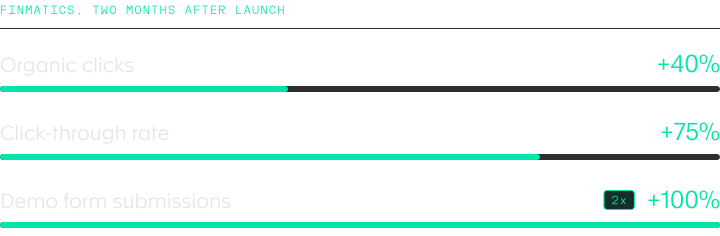
Within two months of launch, Finmatics saw 40% more organic clicks, a 75% higher click-through rate, and twice as many demo form submissions. The work has continued as ongoing CRO and growth support, with the same people who built the site now improving it.
WealthHub
WealthHub, formerly MiltonFMR, is a trading community and financial research platform with a heavy content operation behind it, from research papers and hedge fund letters to courses and strategy articles. The rebrand meant a new name, a new domain, and a website built from scratch.
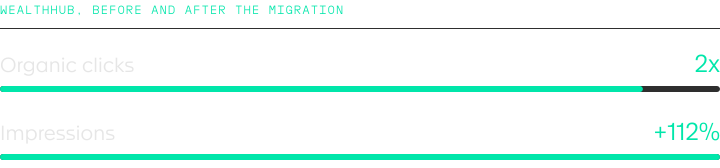
We did all of it in one team: the branding, copy, design, Webflow build, and SEO/GEO. The same people who designed the new site also handled the move from miltonfmr.com to wealthhubtrading.com, so the CMS structure and the redirect map for 250+ migrated blog posts were planned together. The site went live in 6 weeks, and after the migration organic clicks more than doubled and impressions grew by 112%.
Conclusion
Three agencies can each do excellent work and the project can still run slow, because the cost sits in the paths between them and the client carries every path. For a single website stack, one team that designs, builds, ranks, and reports against one goal removes the seams where agency coordination problems start.
If the self-audit came back with three or more yes answers, the useful next step is considering where your setup loses time.
How many marketing agencies should a B2B company work with?
A B2B company should work with the fewest agencies that cover its needs at the level it needs. For one website, that means one team handling design, development, and SEO together. Add a specialist only for a channel that needs separate, deep expertise, such as a large paid media budget, and give that relationship a named owner.
What is an agency of record?
An agency of record is a lead agency that owns strategy and coordinates the other vendors on a brand's roster. It gives the client one main point of contact. The coordination work doesn't disappear, though. It moves from the client's team into the agency, and someone at the agency has to be resourced to do it.
Can one agency cover design, development and SEO well?
Yes, when design, development, and SEO are in one team. Ask any agency claiming all three to show a migration with search data from before and after launch. If the SEO gains only start months after go-live, the disciplines were likely working in sequence.
How long does it take to consolidate agencies?
The timeline depends on your contract notice periods and on whether the consolidation includes a platform migration. Moving scope on an existing site goes faster than a rebuild. Plan an overlap window where the outgoing agency is still reachable, and finish the access audit before anyone gives notice.


Your growth starts with one conversation.
No pitch deck. No pressure. A focused 30-minute call about where you are, where you want to be, and whether we're the right team to get you there.