GEO Strategy for B2B SaaS: Best Practices That Get You Cited
Generative engine optimization (GEO) is the work of getting your pages quoted inside the answers that ChatGPT, Perplexity, Microsoft Copilot and Google's AI Overviews write for your buyers. For a B2B SaaS company, the strategy comes down to picking the prompts your buyers ask, letting the right crawlers in, writing passages that stand on their own, publishing material only you can produce, earning mentions on other sites, and tracking citations every month.

What Is Generative Engine Optimization?
Generative engine optimization is the practice of shaping your content and your web presence so that LLMs cite your pages. GEO sits on top of search engine optimization (SEO), so a page that can't rank has little chance of being cited.
For example, a buyer types "what's the best accounts payable tool for a 50 person finance team" into ChatGPT and gets a shortlist of vendors before visiting a single website. If your product isn't on it, the buyer may never reach your comparison page.
How GEO Relates to SEO and AEO
GEO, SEO and AEO (answer engine optimization) share the same foundation and differ mainly in what counts as a win:
| SEO | AEO | GEO | |
|---|---|---|---|
| Goal | Rank in the links | Be the direct answer | Be cited in the answer |
| Where it shows | Google and Bing results | Featured snippets, voice | ChatGPT, Perplexity, Copilot, AI Overviews |
| Unit that wins | Page | Passage | Passage plus brand mentions |
| Signal you control | Relevance, links | Answer under heading | Quotable facts, off-site mentions |
| How you measure | Rankings, clicks | Snippet ownership | Citation share |
The overlap is huge, because SEO basics are the entry ticket, and GEO is what you add once you have it.
How Do AI Engines Choose Which Sources to Cite?
AI engines choose sources in two passes. A search step finds candidate pages, usually from a web index such as Google's or Bing's, and then the model reads passages from those pages and cites the ones that answer the prompt clearly and can be attributed to a named source.
The sequence, as far as the engines document it, runs like this:
- The engine turns the buyer's prompt into one or more search queries.
- A web index returns candidate pages for those queries.
- The engine pulls the relevant passages out of those pages.
- The model writes the answer and attaches a citation to the passages it leaned on.
Each step is a gate, and a page can fail at any of them. At the index gate, Google requires a page to be indexed and eligible for a snippet before it can appear in AI features. A page with a noindex tag, a blocked crawler or thin content never reaches the passage step at all.
The passage gate is where structure matters. In Kevin Indig's analysis of 18,012 verified ChatGPT citations, 78.4% of citations tied to a question came from a heading, and cited passages were about twice as likely to contain a question mark. Length matters less. For instance, an Ahrefs study of 174,048 pages cited in AI Overviews found a correlation of 0.04 between word count and citation, with 53.4% of cited pages under 1,000 words.
This is why SEO (ranking pages) comes first. When Finmatics relaunched their site, the result was 40% more organic clicks and twice the demo submissions. That’s the SaaS growth that AI engines draw from; pages that already rank and convert are the pages that get retrieved.
Generative Engine Optimization Framework: 6 Steps for B2B SaaS
The six-step generative engine optimization framework is a loop, and the sixth step feeds the first. Tracking shows which prompts you're missing, and those prompts become the next round of pages and outreach.
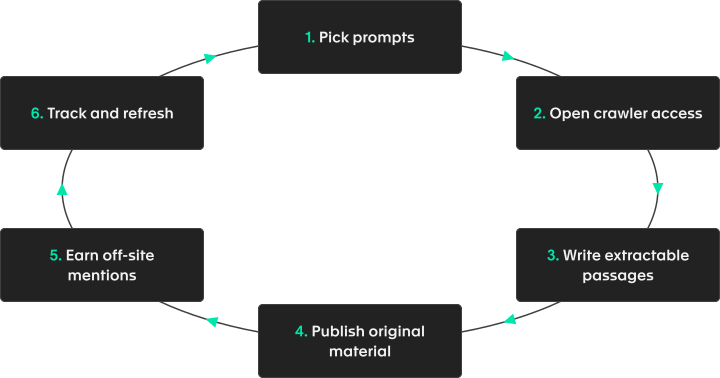
#1. Pick the Right Prompts
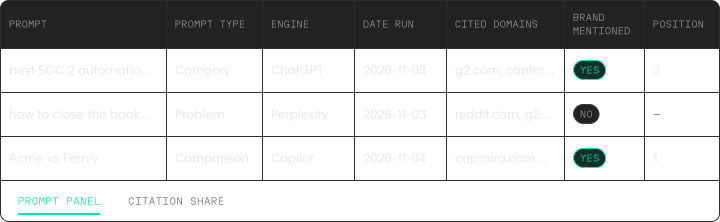
A GEO strategy starts with a fixed list of prompts, because you can't track citations for questions you never wrote down. Twenty to forty prompts is a workable size for one SaaS product, split across three types:
- Category prompts, such as "best SOC 2 automation tools for startups," where the engine builds a shortlist.
- Problem prompts, such as "how to close the books faster with a three person finance team," where your product may or may not come up.
- Comparison prompts, such as "[your product] vs [competitor]," where the engine summarizes differences and you want the summary to be accurate.
Pull the wording from your sales call notes, G2 and Capterra reviews, support tickets, and the long queries in your Search Console Performance report. Buyers phrase things differently from your positioning document, and the engine answers the buyer's phrasing.
#2. Let the Right Crawlers In
AI search crawlers and AI training crawlers are separate bots, and blocking the wrong one removes you from the answers.
OpenAI's crawler documentation splits them clearly. OAI-SearchBot decides whether a site can appear in ChatGPT search answers, while GPTBot collects content that may be used to train OpenAI's models. Blocking GPTBot keeps your content out of training without removing you from ChatGPT search, and blocking OAI-SearchBot does the opposite.
Google draws the same line. Googlebot rules in robots.txt govern Search crawling, AI Overviews included, while Google-Extended controls whether content is used for training and grounding in Google's other AI systems.
#3. Write Passages for Retrieval
An AI engine reads a paragraph on its own, so each one has to carry its own subject. Content rules are simple:
- Answer under the heading. The first paragraph after each heading answers the heading in 40 to 55 words.
- Name things. Write the product, the integration, the standard and the version by name, instead of "the platform" or "this feature."
- One idea per paragraph. Two to four sentences, so a retrieved chunk carries one complete claim.
- Tables for comparisons. Three or more items compared on two or more attributes go in an HTML table, which engines parse cleanly.
- Text stays text. Anything locked inside an image is invisible to the engine. Pricing tiers, feature lists and comparison data belong in the HTML.
Headings and alt text do double duty here, since they serve screen readers and retrieval systems in the same way. A heading structure that skips levels or uses headings as decoration confuses both, and the fixes for improving accessibility tend to improve retrieval at the same time.
#4. Be Unique as Much as Possible
Google's guide to optimizing for generative AI search asks for non-commodity content, i.e. first-hand expertise and a point of view that a summary of other pages can't replace. An AI engine has little reason to cite a page that says what twenty other pages say.
A B2B SaaS company usually has more original material than it publishes, like:
- Product facts nobody else can state, such as exact integration list, data residency regions, implementation timeline, pricing logic.
- Aggregate usage data, including median onboarding time across customers, published with the sample size and date.
- Honest comparison pages that say where a competitor fits better. Engines summarizing a comparison prompt need balanced sources, and a page that concedes nothing reads as an ad.
- Expert commentary from named people on your team, with a linked author page.
Write the fact because it's true and useful. If a number can't be backed up from your own records, leave it out, since an engine that quotes a wrong figure under your brand name does more damage than no citation.
#5. Look for Mentions Outside Your Own Site
AI engines weigh what other sites say about you, especially for category prompts where the answer is a shortlist. A company blog rarely gets cited for "best tool for X", while review platforms, industry publications and comparison articles on other domains often do.
For B2B SaaS, the places that pay off are:
- Review platforms such as G2 and Capterra, with current product descriptions and recent reviews.
- Integration marketplaces and partner documentation, which describe what your product connects to in third-party words.
- Industry newsletters, podcasts and conference talks where your team shares something specific.
- Community threads where your team answers questions openly under real names.
Keep product facts consistent across all of these, because an engine pulling an old G2 pricing model and your new pricing page can merge them into a wrong answer.
#6. Track Citations and Refresh on a Schedule
Run your prompt list once a month on each engine your buyers use, and log which domains get cited and whether your brand appears. Answers change from run to run, so a single check tells you little. The trend across three or four months tells you a lot more.
A prompt where a competitor is cited and you aren't points to a missing page, a weak passage or a missing mention, and a wrong description of your product points to an outdated page somewhere.
Freshness helps, and refreshing sometimes means merging two thin pages into one strong one. When you do, set up 301 redirects from the retired URL so the links and the crawl history carry over.
The payoff from this loop builds slowly. Calda is a good example of the time frame. Over two years of ongoing growth work, the site gained 70% more organic clicks year on year and 3.9 times the impressions. That kind of curve comes from monthly iteration, which is what the sixth step is for.
What Does a GEO-Ready Page Look Like?
A GEO-ready page answers the main question in the opening paragraph, puts a direct answer under every heading, names products and numbers instead of using pronouns, and backs each outside claim with a source named in the sentence.
The difference shows up clearly at the passage level. Here is a vague passage of the kind found on a lot of feature pages:
- Before: It makes redirects really easy, so you won't lose any of your hard-earned traffic when things change.
- After: Webflow stores 301 redirects in Site settings under the Publishing tab, where each rule pairs an old path with a new one. The rules go live at the next publish, and Google passes the old URL's ranking signal to the new address after it recrawls the page.
The second version names the product, the interface location, the redirect type and the sequence, so an engine can quote it without any surrounding context.
At the page level, check for these elements:
- A visible "Last updated" date near the H1.
- A named author linked to a real bio page.
- An opening paragraph that answers the page's main question.
- Headings phrased the way a buyer would ask.
- An answer of 40 to 55 words under each question heading.
- HTML tables for any comparison of three or more items.
- Outside claims attributed in the sentence, with a link.
- Key facts in visible text, with structured data matching what's on the page.
GEO Strategy That Doesn't Work
There are several GEO strategies that have been tested and don’t work, and the table below sums up the evidence:
| Tactic | What the evidence says |
|---|---|
| llms.txt file | Not used by Google Search; 97% of files never fetched in a month |
| Chunking pages for AI | Not needed; no ideal page length |
| Schema added for AI citations | 4.6% drop in AI Overviews in a matched test |
| Keyword stuffing | Lowered visibility |
| Rewriting copy for engines | Largely ineffective, often harmful |
Google's guide is direct about this. The llms.txt files, chunking content, rewriting content for AI systems, seeking inauthentic mentions, and overfocusing on structured data are things you don't need to do. However, structured data is still worth adding for rich results and for describing your article, author and dates, but it isn't a citation lever.
Mass-produced pages are another trap. Spinning up a page for every phrasing of a prompt counts as scaled content abuse under Google's spam policies, and Google's AI guide names it directly. On the other hand, programmatic SEO built on real data, such as one page per integration with specific setup details, is different from templated pages that only swap the keyword.
How Do You Measure GEO Results?
You need several sources to measure GEO results. Each source shows one slice, and the gaps in each are as important as the numbers.
| Source | What it shows | What it misses |
|---|---|---|
| Search Console generative AI report | Google AI feature impressions | Other engines |
| Bing AI Performance report | Copilot citations, grounding queries | Clicks |
| GA4 referral traffic | Sessions from chatgpt.com, perplexity.ai | Answers read without a click |
| Monthly prompt panel | Citation share against competitors | Run-to-run variation |
Google folds AI Overviews and AI Mode traffic into Search Console. Microsoft's Bing AI Performance report in Bing Webmaster Tools goes further on citations, listing grounding queries, cited pages and your citation share, though it doesn't show clicks.
For referral traffic, set up a channel group in Google Analytics 4 that collects sessions from chatgpt.com, perplexity.ai, copilot.microsoft.com and gemini.google.com, so AI traffic stops hiding inside "Referral." Running GA4 on a Webflow site takes one tag in the site's custom code, and the channel group is a settings change after that.
How to Run GEO on a Webflow Site
Webflow covers the technical side of generative engine optimization with settings you already have. Those are an editable robots.txt, an automatic sitemap, clean semantic HTML and CMS fields you can bind to visible page elements. The work is in using them deliberately. For a fuller picture of how Webflow handles SEO, the platform's defaults are a reasonable starting point.
Your robots.txt lives in Site settings under the SEO tab. If you want to appear in AI search answers while keeping your content out of model training, the file separates the two decisions like this:
# AI search crawlers: allow, so you can be cited
User-agent: OAI-SearchBot
Allow: /

User-agent: Googlebot
Allow: /

# AI training crawlers: a separate business decision
User-agent: GPTBot
Disallow: /

User-agent: Google-Extended
Disallow: /

Sitemap: https://www.yourdomain.com/sitemap.xml
Final Thoughts
All in all, the best generative engine optimization strategy in 2026 looks a lot like good SEO with a tracking habit attached. Pages that rank, answer clearly and say something original get retrieved, and mentions on other sites decide whether your name makes the shortlist.
Since generative engine optimization is a monthly loop of content, technical checks, outreach and tracking, outside help makes sense. As an embedded growth partner, Tunel Studio runs SEO and GEO services for B2B and SaaS companies, and handles Webflow development when the fixes need a rebuild rather than an edit.
How long does generative engine optimization take to show results?
Generative engine optimization results depend on recrawling, so timing varies by engine. OpenAI says robots.txt changes reach ChatGPT search in about 24 hours, while new or rewritten pages have to be crawled and indexed first. Citation patterns also shift from month to month, so judge progress on three months of tracking rather than a single check.
Is GEO replacing SEO?
GEO isn't replacing SEO, because AI engines retrieve from the same web indexes that power search results. Google states that AI Overviews and AI Mode rely on its core ranking systems. A page that doesn't rank has little chance of being retrieved, so SEO stays the foundation and GEO adds prompt tracking and off-site mentions on top.
Does GEO work for an early-stage SaaS with little traffic?
GEO can work for an early-stage SaaS, especially on narrow problem prompts where few established pages exist. Publishing precise product facts, documentation and honest comparisons gives engines something specific to quote. Category prompts like "best tools for X" are harder, since they lean on reviews and third-party mentions that take time to build.
Do I need a separate budget for GEO?
You rarely need a separate GEO budget at the start, since much of the work overlaps with SEO and content you already fund. The new costs are the time to run a monthly prompt panel, optional tracking software, and outreach for third-party mentions. Add budget once tracking shows specific gaps worth closing.
Which AI engines matter most for B2B SaaS?
The AI engines that matter most are the ones your buyers use, and that differs by market. Check GA4 referrals from chatgpt.com, perplexity.ai and copilot.microsoft.com, read the "how did you hear about us" answers on demo forms, and ask on sales calls. Put the most effort where those three sources agree.


Your growth starts with one conversation.
No pitch deck. No pressure. A focused 30-minute call about where you are, where you want to be, and whether we're the right team to get you there.