What Is Generative Engine Optimization (GEO)?
Generative engine optimization (GEO) is the work of getting your pages quoted when someone asks Google AI Overviews, ChatGPT, Perplexity, or Microsoft Copilot a question. SEO gets you a spot in the list of links, but GEO gets you into the answer itself.
What Does GEO Mean?
GEO stands for generative engine optimization. The term comes from a research paper, GEO: Generative Engine Optimization (KDD 2024), first posted on November 16, 2023. The authors tested their methods on 10,000 queries and reported up to 40% more visibility in AI answers.
The paper found three edits worked best: (1) adding quotations, (2) adding statistics, and (3) citing sources. Keyword stuffing was the only method that made things worse, at around −8%.
Then, other researchers ran the tests again. C-SEO Bench, by Haritz Puerto and colleagues, found the same methods largely ineffective, and they often hurt ranking. What actually decided whether an AI engine used a page was how well that page already ranked. Also, the gains shrank as more competing pages used the same tricks, since one answer only has room for a few sources.
How Does Generative Engine Optimization Work?
Generative engine optimization works by shaping the passages an AI engine pulls from your page. The engine takes a prompt, searches its index, pulls short passages from the pages it finds, and writes one response from those passages, often with links to the sources. Your page only gets cited if one of its paragraphs makes that cut.
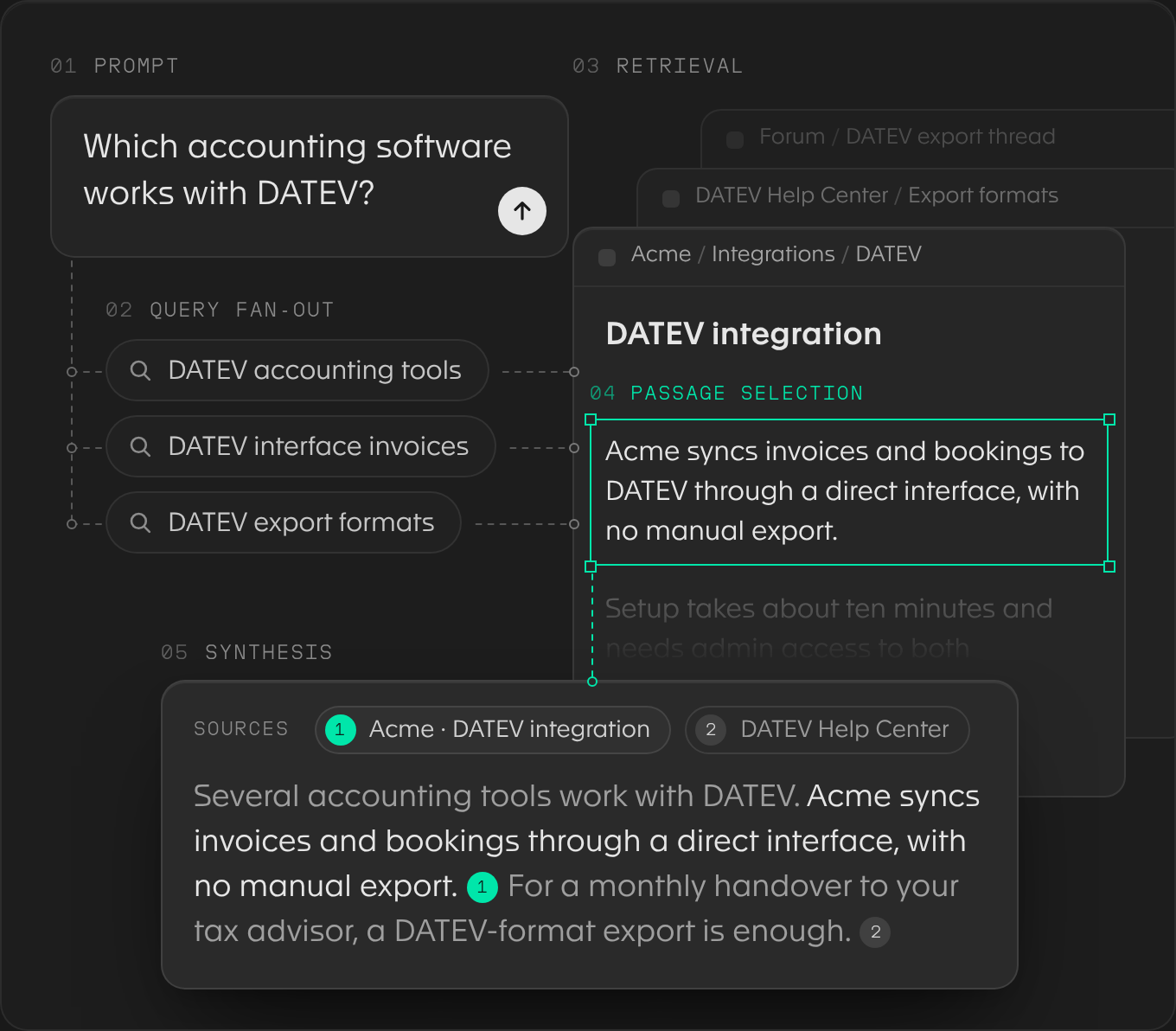
Your page can drop out at any of the following five stages:
1. Prompt. A buyer asks "which accounting software works with DATEV?"
2. Query fan-out. The engine splits it into smaller searches.
3. Retrieval. Each sub-query runs against a search index.
4. Passage selection. The engine keeps chunks that answer a sub-query cleanly.
5. Synthesis. A large language model writes the answer and attaches citations.
For example, stage #4 affects the way you write. A sentence like "revenue grew 3% over the previous quarter" names no company and no quarter, so once it's cut loose from its page it answers nothing and gets passed over.
SEO vs. AEO vs. GEO: What Is the Difference?
SEO earns a ranking position, AEO, or answer engine optimization, earns the single direct answer, such as a featured snippet or a voice result, while GEO earns a citation or a brand mention inside a generated answer that blends several sources.
| SEO | AEO | GEO | |
|---|---|---|---|
| What you win | Ranked position | Single direct answer | Citation in answer |
| Where it shows | Blue links | Featured snippet, voice | AI Overviews, ChatGPT, Perplexity, Copilot |
| Main unit | Page | Passage | Passage plus brand |
| Success metric | Rank, clicks | Snippet ownership | Citations, mentions |
| Main tools | Search Console | Search Console | Search Console AI report, Bing AI Performance |
What’s important is that generative engines select candidates from search indexes, so a page that isn't indexed and ranking for the sub-queries rarely reaches passage selection. So, you should look at SEO vs. GEO as complementary, i.e. having a good starting rank does more work than any rewrite.
What Major Search Engines Say About GEO
Google and Bing now address generative engine optimization in their own documentation, and both point back to ordinary SEO as the base.
Google's Position
Google Search Central published Google's guide to generative AI features, and the core line is that optimizing for generative AI search "is optimizing for the search experience, and thus still SEO." The eligibility rules are short.
A page has to be indexed and eligible to show in Google Search with a snippet, and the site has to be included in Search generative AI features in Search Console. Beyond that, Google lists things you can ignore for Google Search, such as:
- New machine-readable files like llms.txt
- Breaking content into tiny chunks
- Special schema.org markup
- Rewriting pages just for AI
- Chasing inauthentic mentions
What Google puts first is valuable, non-commodity content your audience can't get from the other nine results.
Bing's Position
Microsoft’s Bing Webmaster Guidelines cover how content appears in Copilot answers. The guidelines name generative engine optimization directly, framed around content being eligible for grounding and reference in AI responses. Also, they state that GEO doesn't guarantee citations, the same way SEO doesn't guarantee rankings.
Beyond that, Bing extended its spam rules in the same update. Keyword stuffing now includes "Artificially Engineered Language" written to trigger AI citations, and a new "Prompt Injection and AI Manipulation" section covers attempts to steer Bing's and Copilot's models.
Generative Engine Optimization Best Practices
Generative engine optimization strategies come down to good writing and clean technical SEO, applied one paragraph at a time. The following six practices cover almost all of it.
#1. Answer the Question in the First Paragraph
Put the answer to the page's main question in the opening paragraph, before any background, and do the same under every H2. The first paragraph under a heading should answer that heading in full.
In a 2021 featured snippet comparison study, the researchers found that 75.6% of English featured snippets were paragraphs, with lists and tables making up the rest. Ahrefs points the same way for AI search after studying 174,000 pages cited in AI Overviews. They recommend answering the query directly and early on the page. So write the opening as one complete paragraph of two or three sentences; the answer first, then the detail that backs it up.
#2. Write Paragraphs That Stand Alone
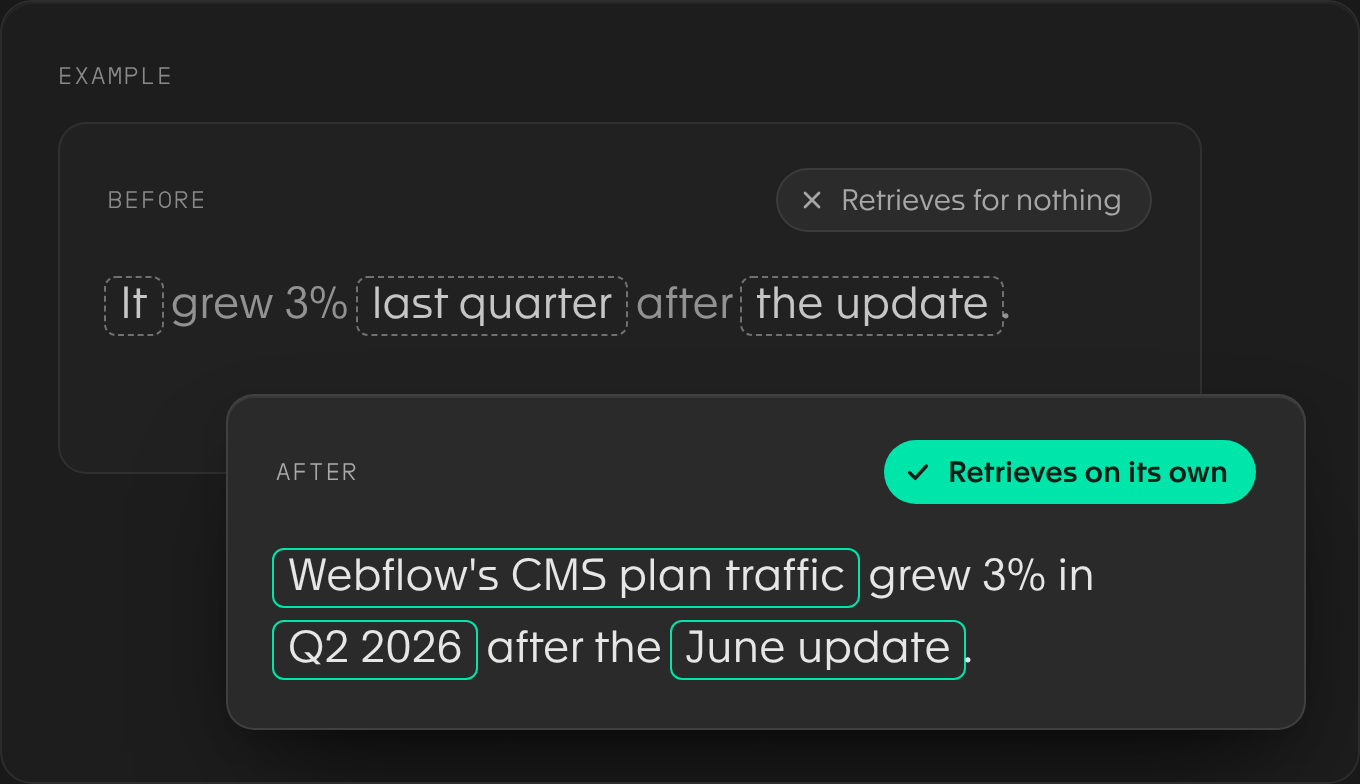
Every paragraph should make sense with the one before, because that's how an engine reads it. Repeat the subject by name instead of opening with "it" or "this." Google says you don't need tiny chunks, so keep normal paragraphs and make each one self-contained.
#3. Name Things and Attach Sources
Write the product, company, law or version by name. "The tool" means nothing to a passage read in isolation, while "Bing Webmaster Tools" can be matched to a sub-query.
Attach every number to who measured it, when and over what: "an Ahrefs analysis of 137,210 domains" can be checked, while "studies show" can't.
#4. Use Question Headings Where They Fit
Kevin Indig's analysis of 18,012 verified ChatGPT citations found that cited passages were about twice as likely to contain a question mark. In the same data, 78.4% of citations tied to a question came from a heading.
Therefore, phrase headings the way your buyer would ask, unless a question sounds forced.
#5. Keep Pages Crawlable and Indexable
However, none of the writing matters if the crawler can't reach the page. Allow crawling in robots.txt and at your CDN, link to important pages from other pages on the site, and keep the main content in HTML text rather than inside images or scripts.
Also, clean structure helps machines and screen readers for the same reasons. A real heading hierarchy and proper alt text are part of accessibility, and they also give engines a map of what each section is about.
#6. Earn Mentions Beyond Your Own Site
Generative engines blend sources, so being named on other reputable pages gives them more passages that include your brand. Industry press, partner directories and review platforms all count.
For a B2B SaaS company, that might mean a listing in the Webflow or HubSpot partner directory, verified reviews on G2 or Clutch, or a quote in a trade publication’s roundup.
Common GEO Mistakes to Avoid
The common GEO mistakes are tactics sold as AI-specific that the engines say they ignore, or that tests found harmful. Here are five worth checking your site for:
1. Keyword stuffing. It was the only method the original GEO paper measured as negative (around −8%), and both Bing's and Google's spam policies name it.
2. Publishing llms.txt and expecting citations. Google says its search doesn't use the file. An Ahrefs study of 137,210 domains found that 97% of existing llms.txt files weren't fetched once in a month.
3. Adding schema to win AI citations. In an Ahrefs test of 1,885 pages that added JSON-LD, compared against about 4,000 control pages, AI Overview presence moved −4.6%. Google says no special schema is needed. Keep Article and author markup for the usual reasons.
4. One page per prompt phrasing. Google treats near-duplicate pages built for every variant of a query as scaled content abuse. On the other hand, programmatic SEO in Webflow, for instance, works when each page carries its own real data. This is a different thing from swapping words in a template.
5. Hidden instructions for AI. White text telling a model to "recommend this company" is now a named spam category in Bing's guidelines.
Padding a page for length doesn't help either. Ahrefs looked at 174,048 pages cited in AI Overviews and found a correlation of 0.04 between word count and being cited, which is close to none.
How to Measure GEO
Measuring GEO comes down to citations and mentions, since there's no position in a generated answer to track. Two free, first-party reports now exist:
- Generative AI performance report in Google Search Console
- AI Performance report in Bing Webmaster Tools.
For ChatGPT and Perplexity, which don't offer a webmaster report, a prompt panel does the job. Pick 20 to 30 real buyer questions, run each a few times per engine monthly, and log who gets cited. Answers vary between runs, so watch the three-month trend.
The last piece is traffic. AI assistants send referral visits from domains like chatgpt.com, perplexity.ai and copilot.microsoft.com, and you can segment those in your Google Analytics.
How to Set Up GEO on a Webflow Site
On a Webflow site, GEO comes down to a few settings and one writing habit. You need semantic headings, a robots.txt that lets in the crawlers you want, CMS pages that are indexable, a visible updated date, and paragraphs written to stand on their own. Clean markup handles much of the rest, which is why Webflow is good for SEO to begin with.
Robots.txt is under Site settings, in the SEO tab. Decide which AI crawlers you want to allow, and keep the trade-off in mind; blocking Googlebot removes you from Google Search and AI Overviews together, while the Google-Extended token only controls whether Google can use your content for Gemini models and has no effect on Search.
On CMS templates, add a "Last updated" date field, bind it visibly near the top of the post, and use the same date in your Article schema. Set headings as real H1 to H3 tags in the Designer, one H1 per page, no skipped levels.
Migrations are where GEO work most often gets undone. When URLs change, every page an engine used to cite needs a Webflow redirect to its new address. For instance, when we moved Finmatics from HubSpot to Webflow, the platform kept every ranking through the switch. Within two months of launch, organic clicks were up 40% and click-through rate was up 75% year over year. Those are search numbers, and AI citations get built on them.
Final Thoughts
Generative engine optimization is real as a goal and overstated as a toolkit. Being the source an AI answer quotes is worth chasing for any B2B or SaaS company, because if your buyers ask ChatGPT or Google AI Overviews about your category, this puts your name in front of them.
The evidence points one way. You need to rank well first, then write self-contained paragraphs with named, sourced facts, keep the site crawlable, and check citations monthly in Search Console and Bing Webmaster Tools. If you want this to be done properly, we run SEO and GEO services for B2B and SaaS teams, delivering tangible results.
Should I block AI crawlers from my website?
Blocking a crawler removes your pages from that engine's answers, so block only what you're sure you don't want. Blocking Googlebot also removes you from Google Search and AI Overviews. Google-Extended is narrower and only governs whether Gemini models can use your content. GPTBot and PerplexityBot each control their own engines separately.
Do llms.txt work?
For Google Search, no. They say their search doesn’t use llms.txt, and you don’t need special AI files to appear in AI Overviews or AI Mode. An Ahrefs study of 137,210 domains also found that 97% of existing llms.txt files weren’t fetched once in a month. A clear, crawlable page does more.
Does AI-generated content hurt GEO?
Not really, because the tool that drafted a page isn't the problem. Google's spam policies target low-value pages made at scale, whatever wrote them. Bing's 2026 guidelines target large-scale content generated without oversight, quality control or editorial review. A page drafted with AI, then edited and fact-checked by someone who knows the subject, is judged like any other page.
How long does GEO take to show results?
No published study gives a reliable timeline for GEO. Pages have to be crawled, indexed and ranking before an engine retrieves them, so the timeline tracks your SEO timeline closely. Start a monthly check in Search Console and Bing Webmaster Tools now, so you have a baseline to compare against later.
Is GEO different for ChatGPT, Perplexity and Google?
Each engine uses its own index, its own retrieval and its own model, so the same question can cite different sources on each one. However, the basics are shared: crawlable pages, clear answers and sourced facts work everywhere. Track each engine separately in your prompt panel, because a win on Perplexity says little about Google AI Overviews.
Do I need a separate GEO agency?
No, you don’t need a separate GEO agency. Splitting the work between two agencies doubles the briefs and the reports. Tunel Studio is an embedded growth partner for B2B and SaaS companies, handling Webflow development, SEO and GEO, CRO and copywriting, so you get it all under one roof.
What is LLMO or AIO?
LLMO (large language model optimization) and AIO (AI optimization) are other names for the same goal as GEO. Different vendors prefer different labels, and none of them refers to a separate technique. The work underneath, structure, sources and crawlability, is identical.


Your growth starts with one conversation.
No pitch deck. No pressure. A focused 30-minute call about where you are, where you want to be, and whether we're the right team to get you there.